CW: Mention of minor medical procedures, photos of bruising and needles
Prefacing this post by reminding you I’m not looking for advice here so please don’t send me any. I will ask when I’m in need of it.
Background
- November 2021 diagnosed with Adenomyosis via ultrasound scan
- March 2022 mirena coil inserted after being denied a hysterectomy on the grounds my M.E. was too severe and would drastically hinder my recovery from surgery
- March 2024 asked for referral back to gynaecology because things were thing far from good or okay
- April 2024 added to the waiting list for a hysterectomy (and oophorectomy for “severe PMS/PMDD”)
- April 2024 started having Zoladex implants and started taking HRT while I wait for the surgery
- August 2024 put on the NHS waiting list for a hysterectomy and oophorectomy, and advised to stay on Zoladex until surgery
Back to Gynaecology
When I went back to my gynaecologist in April 2024, because the mirena coil hadn’t stopped my periods (but had reduced them dramatically) or stopped the adenomyosis pain, my gynaecologist agreed that I could and would have a hysterectomy. Two years before he had refused to put me forward for surgery because of the severity of my M.E. and the impact that would have on my recovery. Surgery is a very weird thing to want! But I left that appointment so relieved that finally I could have the procedure that could well change my quality of life for the better.
In the meantime, his next course of action was to put me into chemical/medical menopause. This would be achieved through Zoladex injections and would also act as a test for how my body and I would cope with surgical menopause. If I coped well in chemical/medical menopause, I would also have my ovaries removed during surgery because of the severity of my suffering with mood swings and mental instability during my menstrual cycle. I was diagnosed with “suspected PMDD” (Pre-menstrual Dysphoric Disorder) years ago.
For me, Zoladex is a temporary solution.
Initially I was to be having Zoladex implants for four months. I then went back to see my consultant and he has now been extended my prescriptions of both Zoladex and HRT until I have surgery.
Zoladex
Every four weeks, I’m wheeled into my GP surgery to have a nurse inject an implant under the skin in my belly. I’m in, out, and back in the car within minutes. I was surprised by how fast it all goes.
Zoladex is used to help treat a number of things, including prostate cancer and breast cancer. It’s not necessarily something I would have chosen to put into my body but there is an element of beggars can’t be choosers here. In layman’s terms it shuts off your ovaries and the hormones that they produce. This means your periods stop, and your hormonal mood fluctations cease. But it also means that your body enters into the state of menopause. The main concern has been for my bone health and so I have been taking prescribed Hormone Replacement Therapy (HRT) from the day I had my first implant injected.
Before the Zoladex appointment
I take painkillers before I go. A friend who’s been down this road before me suggested it would be helpful. I forgot one month and did notice a difference in the hours after the injection.
I also have a squirt of Rescue Remedy (probably a placebo but it’s always made a difference with my fainting after injections). I make sure I have a drink and something sugary with me for just before and straight after. This is more to do with my body’s penchant for passing out through shock than it has to do with M.E. or the Zoladex itself. Two of my siblings are the same. It’s a family trait!

What happens at the appointment
This is for anyone who, like me, likes to have as much information beforehand as possible. I cannot stress how little my consultant told me about Zoladex! When he said injection I imagined an injection you get in your upper arm. Wrong. When he said injection I imagined a standard injection – it’s not. It’s a physical implant that is injected under the skin on your belly. Luckily I googled it beforehand and had a friend who guided me through it all.

Once I’m inside the nurse’s room (it’s always done by a nurse) I have the option of being injected while I’m sat up, or I can lay on the examination table. I always opt to lie down.
The skin on the belly is pinched and then the needle is inserted before the implant is injected under the skin. I always ask for a plaster because I’m not always being given one and then bleed (ever so slightly) on my clothes on the way home.
I’d expected the area to be wiped with an antibacterial wipe, or be told to wait for ten minutes afterwards incase of some kind of reaction. But they really do just ask you to lay back and then jab you! Then you pull your top back down and are off on your merry way.

Some nurses ask if it’d be helpful for me to cough or take a big breath out. But I don’t seem to need to bother; they can just jab it in. It’s more uncomfortable than painful. The key for me is not to look, to the point I actually take my glasses off which means I cannot see a thing!
EDIT – I had my most event implant injected whilst sat up and, for me, that was definitely more uncomfortable and unsavoury. Perhaps because your core muscles are engaged when you’re sitting upright. The injection site also bled with no sign of stopping for quite a few minutes.
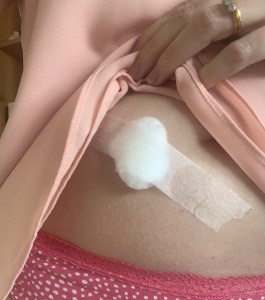
After the appointment
We get me straight home to lay down for the rest of the day. Every thing is a big deal for my body and so this is really quite something.
I block off at least a couple of days where nothing/very little is required of me. As my health picks up because the Zoladex is working, I am back on my feet a little bit quicker. But it’s about a week before I’m asking too much of myself. My body’s equilibrium is easily upset.
I don’t sleep too well the night of the implant. I definitely feel peculiar and my chest feels like it radiates heat. The entry site of the injection also feels tender.
Full disclosure, for the first few months I passed out a few minutes after each implant. This is likely more to do with my body and its usual dramatics than it is to do with anything else.
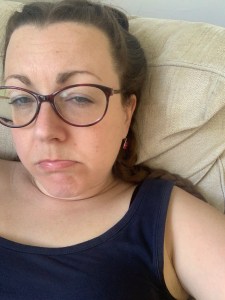
So how is it going?
Part of me wonders if this is the best medical treatment I have ever received! But of course, with M.E., I actually haven’t received anything close to treatment before…

I’d say it’s been fine but I’m coming to see that I no longer have any idea of what fine actually means to people who haven’t lived 14 years in a body that doesn’t have the strength to push the button that opens a microwave door (you know the one).
As someone who has lived with M.E. it’s been something of a breeze, but then nearly everything is when it’s compared to such an audacious illness as M.E.
It has passed by in something of a blur as the new medication triggered a worsening of my already present cognitive dysfunction (brain fog if you will but that term has been so diluted in recent years by the media).
Zoladex has certainly changed things for the better. My periods have stopped and the crippling pain my menstrual cycle brings has also gone!
There is a different kind of exhaustion – my eyes haven’t felt like they’ve been properly open since April. I have had days where I have given in to the sleepiness and napped. But it remains much better in terms of my M.E. if I refrain from napping. Not ideal, but then few things are. The menopause/HRT fatigue is very, very different from M.E. fatigue for me.
The reduction, or almost-eradication, of the PMDD and the Adenomyosis pain and digestive issues, has been life-changing, even though I still very much have M.E. every second of every day. Until it was taken away I hadn’t quite grasped just how unbearable things had become. Survival mode hey!
I feel like me again. Admittedly that’s me with M.E. but that’s who I have to be and I’m making my peace with that.
HRT
I seem to be in a very tiny minority of people who haven’t had to navigate any kind of menopausal state without a fight for HRT. My consultant really stressed how vital it was that I be on HRT from the very first day on Zoladex. This was because of the risk to my bones.
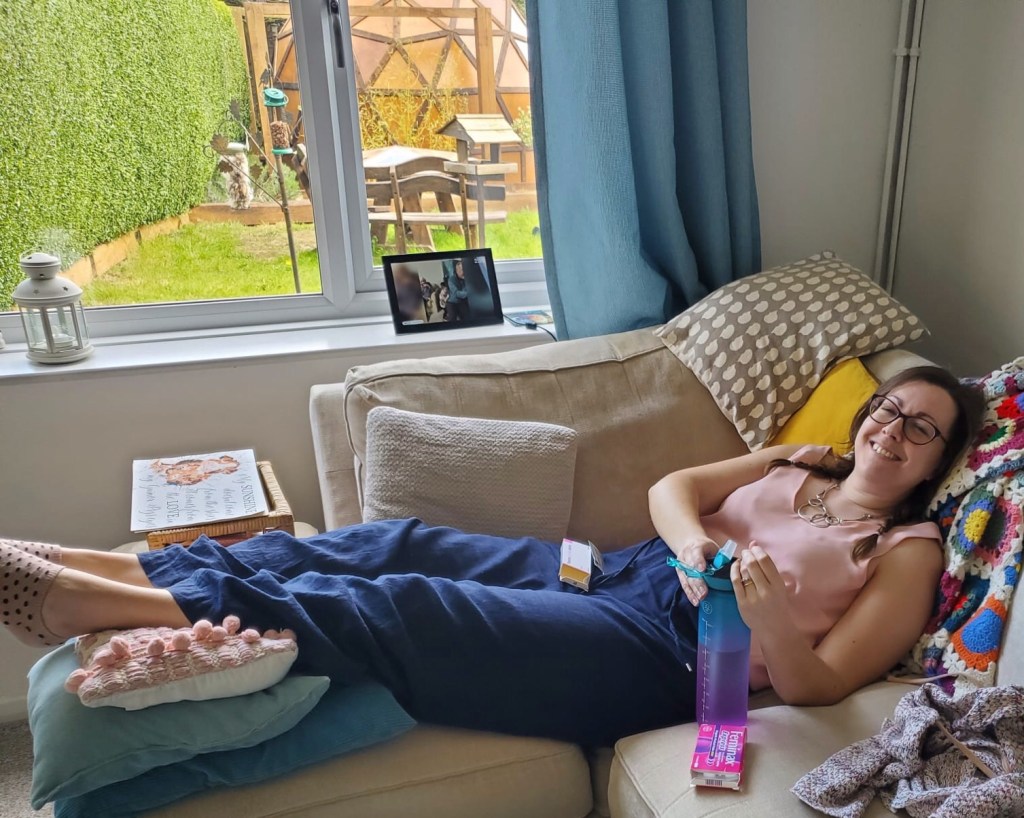
Blood clots are my biggest concern. I hope it’s obvious to you by now that I cannot exercise (because of the incredibly detrimental affect activity and exercise have on a body with M.E.) But I am trying to move in the ways I can. Depending on what kind of day I’m dealt, this ranges from wriggling my toes, to rotating my ankles, to stretching my arms above my head, to walking down our garden path.
Wearing off
I have found that Zoladex is losing its strength as the months go on. The pain is starting to return in the week before my next implant. The numbness and instability of PMDD also come back in the final few days.
Chemical/medical menopause
Things I’ve noticed:
- My most noticeable change has been an increase in brain fog/cognitive dysfunction (already a symptom due to M.E. Word finding has become quite something)
- Hair loss (already an M.E. symptom)
- Hair breakage
- Greasier hair
- A very, very itchy scalp
- Hot flashes (already an M.E. symptom but a different kind) This is my main concern as we know temperature issues can trigger my temporary paralysis (my worst M.E. symptom)
- Insomnia (pretty annoying after years of working on my sleep routine)
- Changes to my sleep (frequently waking in the night)
- Vaginal atrophy (not yet as bad as I was worried it’d be)
- Nausea (already an M.E. symptom but this has absolutely rocketed and I feel like I could throw up multiple times a day)
- Reflux
- An increase in joint pain, particularly hips, knees and knuckles (I’m taking calcium and vitamin D for this and it is actually helping)
- Vertigo (already a symptom I have with M.E.)
- Tiredness/sleepiness (VERY different from my M.E. fatigue/exhaustion)
- Pins and needles/tingling in lower legs and feet, lower arms and hands (again, something I’ve experienced with M.E. but now far more frequent/countless times a day)
- Night sweats (yet again something I’ve already experienced with M.E. and I’d say they haven’t been awful yet).
Comparing all of these things to how hard things were before Zoladex, I would choose them over the pain and PMDD every day of the week!
So what next?
Next comes surgery. I’m waiting for a hysterectomy and oophorectomy (removal of uterus and ovaries and fallopian tubes). I am aware that surgery could just move things sideways rather than forward; swapping one issue for another. But I am daring to hope for an improved quality of life. Adenomyosis heavily affects my M.E. Removing my uterus will not eradicate my M.E., but the last few months have shown how much worse the pain and the PMDD was making my already tricky situation.
I’m not yet in a position to answer any queries or offer advice; this feels so huge for me that I have to keep my focus and keep my mind calm. I’m also not in a position to cope with unsolicited advice, or trauma dumping. That applies to everything; not just this topic.
I will talk about it when I feel I want to but hearing others’ experiences at the moment isn’t helpful for me except where I have explicitly asked for it (from a handful of friends who’ve been so selfless is guiding me through this)
I’m doing my absolute best to savour each moment that I’m not in pain.
Because we have no idea what recovery from surgery will look like, and I think I’ll be very lucky if they don’t uncover Endometriosis while they’re removing my faulty uterus…
All these years I never really considered myself to be in pain. But I think I was wrong; I think I was just so used to suffering and exhaustion that I didn’t realise some of that was a result of pain. Now that that pain has temporarily been removed it’s obvious to me how hard I had it these last few years.

 'M.E. myself and I' by Anna Redshaw